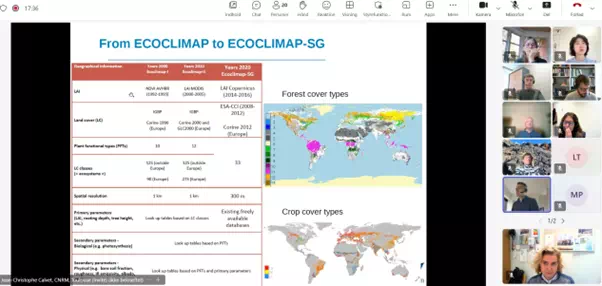
The GreenEO consortium recently held an internal webinar titled “Land Surface Data to Be Used: ECOCLIMAP-SG,” bringing together researchers from the project’s consortium to discuss how this comprehensive land surface dataset can best support the project’s goals.
The session aimed to ensure a shared understanding of the ECOCLIMAP-SG data and evaluate whether it meets the needs of GreenEO’s various applications in cities, agriculture, forests, and biodiversity.
Understanding ECOCLIMAP-SG
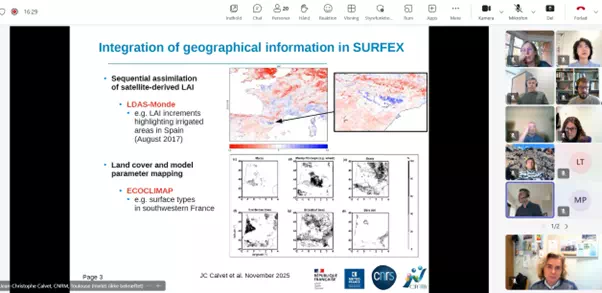
The webinar opened with an overview of the ECOCLIMAP-SG dataset, presented by Jean-Christophe Calvet (Météo-France). ECOCLIMAP-SG is a high-resolution land surface classification that integrates satellite observations, climate data, and biophysical parameters. It provides a consistent representation of land cover and land use across Europe, essential for modelling ecosystem functions and their responses to environmental pressures.
Integrating Data into Models
Following the introduction, David Simpson (MET Norway) presented the implementation of ECOCLIMAP-SG within the EMEP model, discussing both its advantages and the challenges encountered during integration. Paul Hamer (NILU) continued the discussion with a presentation on SURFEX data and its link between land surface modelling and nitrogen deposition. The session also included an update on high-resolution emissions from Susana Lopez-Aparicio and Henrik Grythe (NILU), showcasing recent progress and insights relevant to GreenEO’s ongoing analyses.
Next Steps and Collaboration
The webinar concluded with an open discussion on how the ECOCLIMAP-SG dataset can be applied across GreenEO’s work packages. The session helped clarify where the dataset is most relevant within the project’s ongoing work.
This webinar not only reinforced collaboration across the consortium but also highlighted the shared objective of using Earth observation data to better understand and develop Europe’s climate resilience.